Whey vs Plant Protein: Pea, Soy and Rice Compared on Amino Acids, Muscle Gain and Digestion
Whey vs pea, soy and rice protein: leucine per 25 g, DIAAS scores, what muscle-gain trials found, lactose and allergies, and who should pick which.

We include products we think are useful for our readers. If you buy through links on this page, we may earn a small commission.
I’m Fred, a marketer—not a doctor or dietitian. AI helps me draft these comparisons, and I link research claims to their original sources so you can check them. The direct answer: whey generally delivers more leucine and digestible essential amino acids per gram, but pea, soy and well-formulated plant blends can support similar muscle gains when you consume enough total protein and train consistently.
The short answer
- Whey wins on protein quality per gram. It is rich in essential amino acids, especially leucine, and is rapidly digested.
- Pea protein is the strongest simple dairy-free alternative. It contains all nine essential amino acids, although methionine is relatively low, and direct trials have found muscle outcomes comparable with whey under some conditions.
- Soy is the most balanced single plant option. Its amino acid profile and digestibility are generally stronger than pea or rice, while resistance-training studies often find no meaningful disadvantage versus whey when doses are appropriately matched.
- Rice works better in a blend. It is relatively low in lysine, so combining it with lysine-rich pea protein produces a more balanced amino acid profile.
- Your best choice depends on diet, digestion and cost per 25 grams of actual protein. Choose whey for maximum leucine efficiency; choose plant protein for vegan diets, milk allergy or better personal tolerance.
Pea protein vs whey at a glance
Comparing equal scoops can be misleading because serving sizes and protein concentrations differ. The table instead considers 25 grams of actual protein. The leucine column comes from one laboratory analysis of commercial protein isolates (Gorissen et al., 2018). Amino acid values vary with the raw material and processing, so individual products can differ: NOW Sports Pea Protein, for example, lists 2,009 mg of leucine per 24 g serving on its label, about 2.1 g per 25 g of protein. Check the product’s amino acid panel when one is supplied.
| Protein source | Leucine per 25 g protein (lab analysis) | Typical limiting amino acid | Protein-quality picture | Dietary fit |
|---|---|---|---|---|
| Whey isolate or concentrate | About 2.7 g | None at ordinary adult requirements | Usually the highest digestibility and essential-amino-acid availability of these options | Vegetarian, but not vegan; unsuitable for milk allergy |
| Pea isolate | About 1.8 g | Methionine and cysteine | Good, but generally below whey and soy on DIAAS | Vegan and naturally dairy-free |
| Soy isolate | About 1.7 g | Methionine and cysteine | One of the highest-quality single plant proteins | Vegan and dairy-free; unsuitable for soy allergy |
| Brown-rice protein | About 1.8 g | Lysine | More limited alone; complementary to pea | Vegan, dairy-free and soy-free |
Put another way, the same analysis estimated that matching the 2.7 g of leucine in 25 g of whey protein takes about 37 g of brown-rice protein, 38 g of pea protein or 40 g of soy protein (Gorissen et al., 2018).
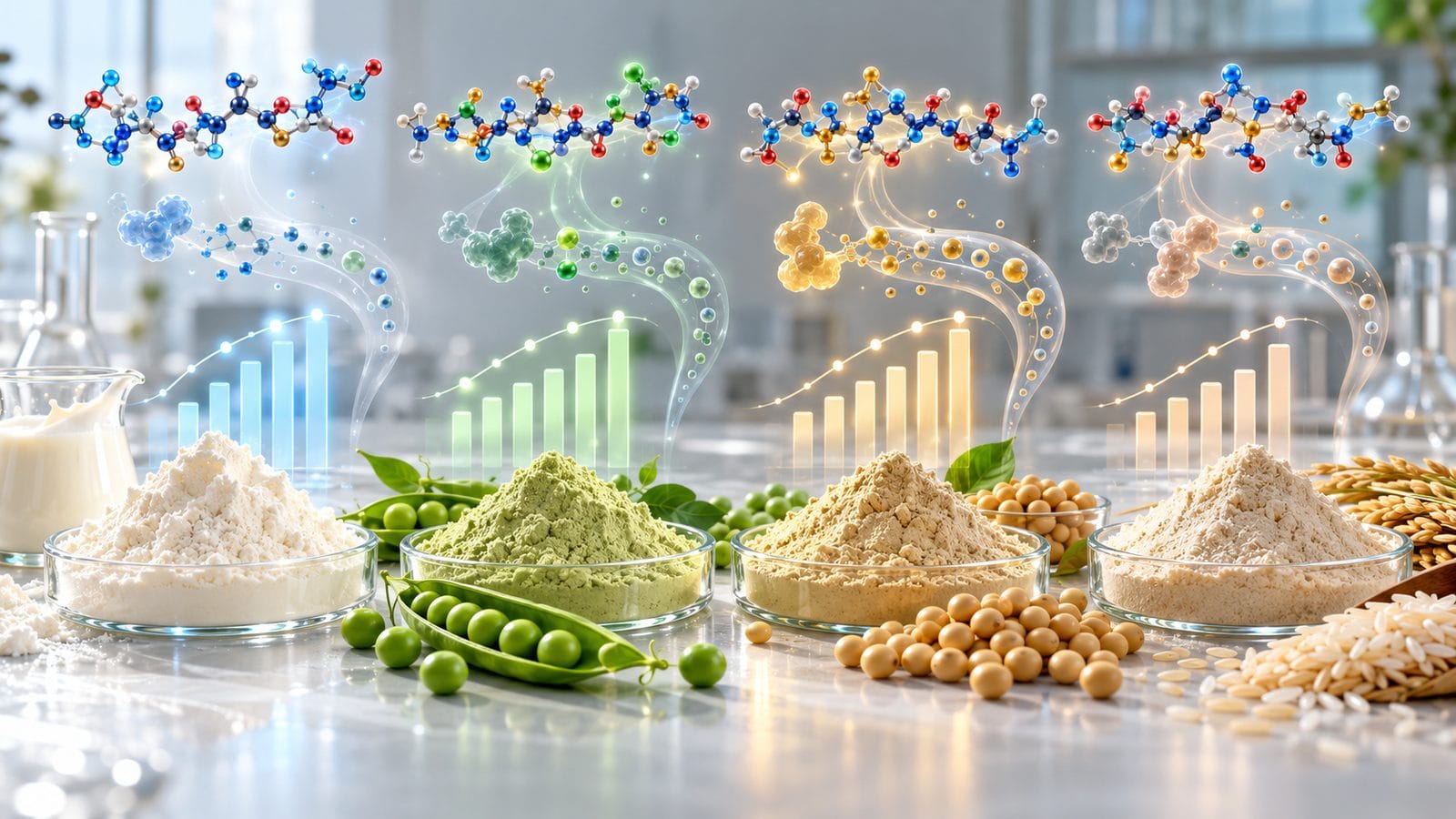
A laboratory analysis of commercial protein isolates found substantial differences in essential-amino-acid content both between sources and among plant proteins. Whey contained a larger essential-amino-acid fraction overall, while plant proteins tended to provide less methionine or lysine. That variation is why the label and ingredient-level amino acid data matter more than a blanket claim that every plant powder is equivalent to every whey powder (Gorissen et al., Amino Acids, 2018).
Leucine deserves attention because it helps signal the muscle-building response to a protein-containing meal. It is not, however, the only requirement: muscle protein synthesis also needs the full set of essential amino acids. Adding isolated leucine cannot turn an otherwise inadequate diet into a complete one.
Amino acids, PDCAAS and DIAAS explained
Whey, pea, soy and rice are all sources of complete protein in the literal sense that they contain every essential amino acid. “Complete” does not mean that each supplies those amino acids in the same proportions or that the body digests all of them equally well.
Whey is naturally rich in branched-chain amino acids, including leucine. Pea supplies plenty of lysine but relatively little methionine and cysteine. Rice has the opposite weakness: it contributes sulfur-containing amino acids but is relatively low in lysine. That makes pea and rice a sensible complementary blend. Soy has a comparatively balanced essential-amino-acid profile, although its sulfur amino acids remain lower than whey’s.
What the quality scores measure
PDCAAS—the protein digestibility-corrected amino acid score—combines a protein’s limiting amino acid with overall fecal protein digestibility. Values are conventionally capped at 1.0, which makes several high-quality proteins appear equal even when their amino-acid digestibility differs.
DIAAS, or digestible indispensable amino acid score, uses the digestibility of each essential amino acid at the end of the small intestine. The Food and Agriculture Organization’s protein-quality report proposed DIAAS as a more informative approach, although PDCAAS remains common on labels and in regulations. Scores depend on the ingredient, processing method, reference age group and test method; there is no universal score for every powder made from a given crop.
In one direct ingredient study using the reference pattern for people aged three and older, whey isolate had a DIAAS of 125 and a PDCAAS-like value of 122, whey concentrate scored 133 and 134, pea protein concentrate scored 73 and 84, and soy isolate scored 98 and 102, respectively. These were experimental values derived from a pig model, not clinical outcomes in people, but they illustrate how PDCAAS can overstate some lower-quality proteins and hide quality above its usual cap (Mathai et al., British Journal of Nutrition, 2017).
A broader review found considerable variation within each food category. On average, whey and soy reached the review’s high-quality DIAAS category, while pea and rice were generally lower; appropriately chosen plant combinations improved the result (Herreman et al., Food Science & Nutrition, 2020). This does not mean pea protein “doesn’t count.” It means a somewhat larger serving, a complementary blend or a varied diet may be useful when plant protein provides most of your daily intake.
Muscle protein synthesis and long-term muscle gain
Acute muscle protein synthesis and months-long muscle growth are related but different outcomes. Whey usually raises circulating essential amino acids more quickly and to a higher peak. That makes it an efficient way to deliver a leucine-rich dose, particularly when appetite or serving size is limited. It does not prove that whey will always produce more muscle over a complete training program.
In healthy young men, 30 grams of pea-derived protein and 30 grams of milk-derived protein produced the same measured post-meal muscle protein synthesis rate over five hours, despite the milk protein causing a larger increase in circulating essential amino acids (Pinckaers et al., European Journal of Nutrition, 2024). This was a small, short-term study, so it should not be treated as the final word on every person or dose.
A separate experiment comparing whey, pea and insect protein after resistance exercise found higher circulating amino-acid concentrations after whey, but no difference among sources in the measured activation of the mTORC1 signaling pathway (Hermans et al., Sports Medicine, 2023). Signaling markers are mechanistic clues rather than direct measurements of new muscle mass.
Longer trials are more practically useful. In sedentary adults completing an 84-day resistance program, pea and whey groups did not differ significantly in changes in whole-body strength or muscle mass (Singh et al., Nutrients, 2024). The study was industry-connected, and its training schedule and population limit how widely the result can be generalized.
Older adults may need particular attention to dose and protein quality because their muscles can respond less strongly to feeding. In a controlled trial of older men, adding two daily 25-gram servings of either whey or pea increased integrated myofibrillar protein synthesis above the participants’ baseline diet; collagen did not produce the same result (McKendry et al., American Journal of Clinical Nutrition, 2024).
What about whey vs soy protein?
Soy has more direct training research than most other plant proteins. In a 12-week supervised resistance-training trial, whey and soy produced no significant differences in muscle growth or strength when servings were matched to provide 2 grams of leucine. The soy serving contained more total protein because soy supplies less leucine per gram (Lynch et al., International Journal of Environmental Research and Public Health, 2020).
The fairest conclusion is that whey has a biochemical advantage per gram, but adequate plant-protein doses can narrow or eliminate the practical difference. Resistance training, total daily protein, energy intake, sleep and adherence are likely to matter more than small differences between two suitable powders.
Digestion, lactose and allergies
Whey comes from milk. Whey concentrate retains more lactose, fat and non-protein material than whey isolate, although the exact amount depends on processing. Whey isolate is more highly filtered and usually contains much less lactose, but “isolate” does not automatically guarantee zero lactose. Anyone comparing options for sensitivity should read the nutrition facts, allergen statement and ingredient list rather than relying on the front of the package.
People with lactose intolerance may tolerate a low-lactose whey isolate even if concentrate causes bloating, gas or diarrhea, but individual thresholds vary. The National Institute of Diabetes and Digestive and Kidney Diseases advises checking labels for milk, lactose and whey when managing lactose intake. A genuinely dairy-free powder avoids the issue altogether. See the guide to lactose-free protein powder for the distinctions among dairy-free products, low-lactose whey and products with added lactase.
Lactose intolerance is not the same as milk allergy. Someone with a milk-protein allergy should not assume whey isolate is safe merely because little lactose remains. Pea, rice or another non-dairy source is the more relevant category, subject to the person’s other allergies and medical advice. Soy protein is also a major-allergen ingredient and is not appropriate for people with soy allergy.
Plant powders can cause digestive complaints too. Pea and rice isolates contain far less fiber and fermentable carbohydrate than whole peas or brown rice, but flavored products may add inulin, sugar alcohols, gums or large amounts of sweetener. Those additions—not the protein itself—may explain bloating in some users. An unflavored isolate with a short ingredient list makes it easier to identify what you tolerate.
If you are pregnant, buying protein for a child, or managing kidney disease, ask a doctor or registered dietitian before using a supplement routinely. Protein powder is concentrated food, but the appropriate amount and ingredient restrictions depend on the individual.
Taste, texture and everyday use
No source has a universally better taste. Whey generally dissolves more readily and tends to create a thinner, smoother drink. Pea protein is commonly described as earthy and can feel thicker or slightly chalky. Rice protein can be gritty, while soy isolate often mixes smoothly but may retain a noticeable bean-like flavor. Flavoring systems, particle size, gums and preparation can change the experience substantially.
Whey’s neutral dairy character works easily in shakes and oatmeal. Pea’s thickness can suit smoothies or baked recipes, while a pea-rice blend may soften the dominant flavor of either ingredient. Soy is useful where emulsification and a creamier texture are wanted. These are formulation tendencies, not promises about any particular product.
If sweeteners bother you, compare unflavored powders first. Otherwise, check whether the formula uses sugar, stevia, monk fruit, sucralose or sugar alcohols. The broader guide to how protein powder is made and how to choose explains isolates, concentrates and ingredient lists in more detail.
How to compare value without being fooled by serving size
Package price alone does not show which option is economical. One serving might provide 18 grams of protein and another 27 grams. A fair calculation is:
Price per 25 g protein = package price ÷ total grams of protein in the package × 25.
Use the labeled protein per serving multiplied by the number of servings to calculate total protein. Also consider whether a lower-leucine plant product requires a larger serving to meet your goal. Whey concentrate is often the value-oriented whey form, while isolate’s extra filtration may carry a premium. Plant isolates and blends vary widely according to source and formulation, so there is no permanent price winner.
For quality screening, rely on checkable information: grams of protein, ingredients, sweeteners, milk or soy allergen statements, lactose information and price per 25 grams of protein. Athletes subject to drug testing can look for NSF Certified for Sport or Informed Sport. These programs address manufacturing and banned-substance risk; they do not prove that one protein source builds more muscle.
Heavy-metal testing is another reason to favor transparent certification over vague “clean” marketing. A certification or published lot result should identify what was measured and by whom. Do not infer purity from “natural,” “plant based” or a premium price.
If you want to try each type
Three unflavored or lightly flavored powders sold on iHerb US, one per type, with short ingredient lists. Prices checked on 29 October 2026; price per 25 g of protein = one-time price / (servings x protein per serving) x 25. The iHerb page is the final word on price.
Whey isolate: NOW Sports Whey Protein Isolate, unflavored, 5 lb
24 g of protein per serving, about 81 servings, no sweetener. Listed in the Informed Sport database (sport.wetestyoutrust.com), which matters if you are drug-tested. One-time iHerb US price $120.28, which works out to $1.55 per 25 g of protein. See it on iHerb
Pea isolate: NOW Sports Pea Protein, pure unflavored, 2 lb
24 g of protein and 2,009 mg of leucine per 33 g serving, about 27 servings, unsweetened. The cheapest protein per gram of the three; expect the earthy taste and thicker texture described above. One-time iHerb US price $23.53, which works out to $0.91 per 25 g of protein. See it on iHerb
Pea and rice blend: California Gold Nutrition Sport Vegan Protein, vanilla, 2 lb
Pea protein isolate plus brown-rice protein, 20 g of protein per 31 g serving, about 29 servings, sweetened with stevia. The blend covers pea’s low methionine and rice’s low lysine. One-time iHerb US price $43.95, which works out to $1.89 per 25 g of protein. See it on iHerb
Who should pick whey, pea, soy or rice?
Choose whey when
- You want the most leucine and essential amino acids from a relatively small serving.
- You eat dairy and tolerate it well.
- You prioritize easy mixing or need to add protein without much volume.
- You want the strongest overall research base for post-exercise protein feeding.
A concentrate can be reasonable if lactose is not a concern. An isolate is the more logical whey form when you want higher protein concentration and less lactose, though labels still need checking. The guide to whey protein isolate covers that choice in depth.
Choose pea protein when
- You follow a vegan diet or avoid dairy.
- You need a soy-free plant protein.
- You prefer a single plant source with a relatively strong lysine and leucine profile.
- You tolerate pea isolate better than whey or multi-ingredient blends.
A 25-gram protein serving can be effective, but people seeking a whey-like leucine dose may need a somewhat larger portion or a complementary blend. Our pea protein powder guide explains isolates and blended formulas.
Choose soy protein when
- You want one of the most nutritionally complete and well-studied plant proteins.
- You are comfortable consuming soy and have no soy allergy.
- You value a generally smooth texture and strong protein density.
Choose rice or a pea-rice blend when
- You need a dairy-free and soy-free option.
- You prefer not to rely on pea alone.
- You want complementary amino acids: lysine from pea and sulfur amino acids from rice.
For most vegan shoppers, a pea-rice or multi-plant blend is the easiest all-purpose choice, provided it supplies a meaningful amount of protein without an unnecessarily long additive list. Compare the options in the guide to vegan protein powders.
Frequently Asked Questions
Is pea protein as good as whey for building muscle?
It can be when total protein, serving size and resistance training are adequate. Whey supplies more leucine and digestible essential amino acids per gram, but direct pea-versus-whey studies have often found comparable muscle or strength outcomes. Whey remains the more efficient option per gram; pea remains a credible dairy-free alternative.
Is plant-based protein powder good for you?
Plant-based protein powder can be a useful way to fill a dietary protein gap. Its value depends on the amino acid profile, serving size, ingredients, contaminant controls and the rest of your diet. It is not automatically healthier than whey simply because it comes from plants, nor is it inherently inferior. Choose a transparent formula and treat it as a supplement to varied meals.
Does pea protein contain enough leucine?
Pea protein contains a meaningful amount of leucine: about 1.8 grams per 25 grams of protein in one laboratory analysis, and about 2.1 grams on the label of at least one commercial pea isolate. That is less than the roughly 2.7 grams in the same amount of whey. A larger pea serving, a fortified formula or adequate protein across the full meal can close part of the difference.
Is whey isolate safe for lactose intolerance?
Whey isolate usually contains much less lactose than whey concentrate, and many lactose-intolerant people can accommodate small amounts. It is not guaranteed to be lactose-free, however, and tolerance varies. Check the carbohydrate and lactose information and choose a certified lactose-free or dairy-free product if even small amounts cause symptoms. Whey is not appropriate for a milk-protein allergy unless a doctor specifically says otherwise.