Marine vs Bovine Collagen: Sources, Types, Which to Buy
Marine collagen is mostly type I from fish skin; bovine is types I and III from cattle hide. No head-to-head trial shows either is better, and bovine was cheaper per 10 g in every pair we compared.


We include products we think are useful for our readers. If you buy through links on this page, we may earn a small commission.
I’m Fred, a marketer—not a doctor or dietitian. AI helps me draft, and I link every research claim to its source so you can check the evidence yourself. The direct answer: marine collagen peptides are the more logical choice for someone avoiding cattle or prioritizing fish-derived type I collagen, while bovine collagen peptides usually provide the more practical all-purpose option. Current research does not establish that marine collagen is inherently better than bovine collagen for skin or joints.
The short answer
- Marine collagen usually comes from fish skin or scales and is predominantly type I collagen. It may suit people who avoid bovine ingredients, but it is unsuitable for anyone with a fish allergy.
- Bovine collagen usually comes from cattle hides and contains mostly types I and III. It is widely used for general skin, bone and connective-tissue supplementation.
- Human trials suggest that some hydrolyzed collagen preparations may modestly support skin hydration or elasticity and joint comfort, but study quality, formulations and funding vary considerably.
- There is no convincing head-to-head evidence showing that the source alone—marine versus bovine—determines the better result.
- Choose by source, allergen status, protein per serving, ingredients, independent certification and normalized cost—not by “premium” language or unsupported absorption claims.
Marine vs bovine collagen at a glance
| Factor | Marine collagen peptides | Bovine collagen peptides |
|---|---|---|
| Typical source | Fish skin, scales or bones, commonly recovered from seafood processing | Cattle hides and sometimes bones, commonly recovered from meat processing |
| Collagen types before hydrolysis | Predominantly type I | Predominantly types I and III |
| Most plausible use | General collagen supplementation, especially when a fish-derived source is preferred | General collagen supplementation when cattle-derived ingredients are acceptable |
| Skin evidence | Some positive trials, but no clear proof that marine is superior | Some positive trials, but no clear proof that bovine is superior |
| Joint evidence | Less source-specific evidence; not equivalent to native type II collagen | More common in hydrolyzed-collagen studies, though results cannot be generalized to every formula |
| Main allergen concern | Fish; the species should be declared on a compliant US label | Beef allergy, including possible alpha-gal concerns; cross-contact depends on the facility |
| Dietary or cultural fit | May fit pescatarian or some religious preferences, subject to individual interpretation and certification | May be acceptable to people who eat beef; halal or kosher status requires specific certification |
| Sustainability question | Can use seafood by-products, but fishery and species traceability matter | Can use meat-industry by-products, but cattle production has broader environmental impacts |
| Value comparison | Compare both cost per 10 g of collagen and cost per 25 g of actual protein using current label and retailer data | |
The word marine describes an origin, not a clinical grade. Likewise, grass-fed describes cattle management more than the peptide composition of the finished hydrolysate. Neither phrase substitutes for an ingredient list, allergen declaration, protein amount or independent certification.
What collagen type and source actually mean
Collagen is a structural protein built from amino-acid chains arranged into a characteristic triple helix. Manufacturers extract collagen-rich material and hydrolyze it into smaller peptides that dissolve more readily. Once collagen has been extensively hydrolyzed, its original tissue structure has been broken apart. That is why “type I” or “types I and III” on a peptide powder should not be interpreted as intact collagen traveling directly to matching tissues.
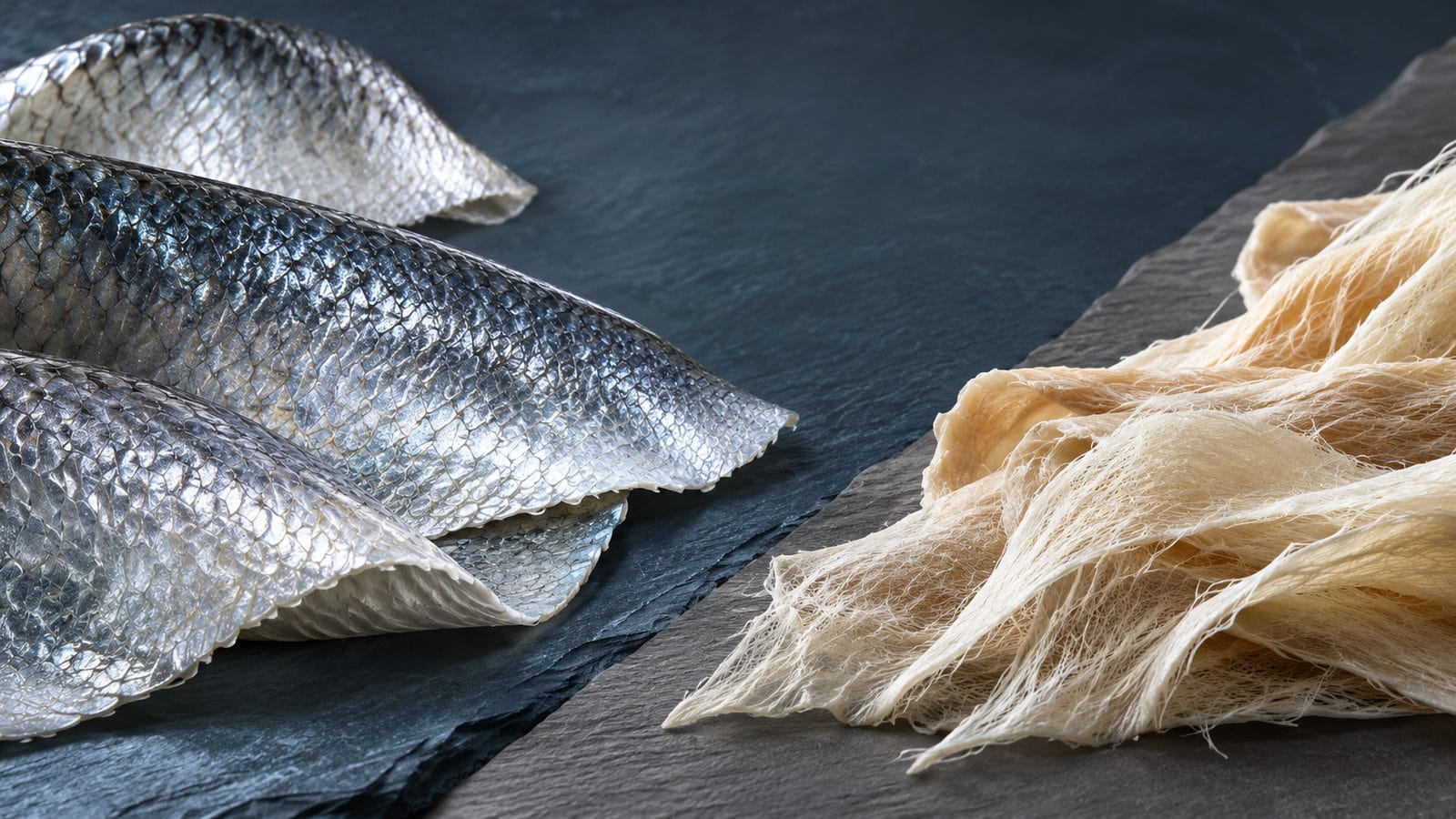
Marine collagen is commonly extracted from fish skin and scales. These tissues are rich in type I collagen, the major collagen type in skin, bone and tendons. Bovine hide is also rich in type I and contains type III collagen, which occurs alongside type I in tissues such as skin. This sounds like an important advantage on a label, but the clinical significance after digestion is uncertain.
Both products supply glycine, proline, hydroxyproline and other amino acids. Digestion produces free amino acids and small peptides, some of which can appear in circulation. Those materials may provide building blocks or biological signals, but they do not let the body bypass normal digestion and tissue regulation.
Hydrolyzed collagen peptides should also be distinguished from undenatured or native type II collagen. Native type II products are usually made from chicken cartilage and are studied at much smaller quantities through a different proposed mechanism. A 10 g serving of hydrolyzed bovine collagen is therefore not interchangeable with a capsule containing native type II collagen.
Collagen is not a complete protein because it lacks tryptophan and has an amino-acid pattern that is less suitable for replacing a balanced dietary protein. If muscle protein or total protein intake is the main objective, read our comparison of collagen vs whey protein and guide to how protein powder is made and how to choose.
Skin evidence: promising signals, important limitations
Collagen supplements have more direct human research for skin outcomes than many beauty supplements, but “more research” does not mean the question is settled. Trials differ in peptide source, dose, duration, added nutrients, participant age and measurement method. Many are small, and commercial involvement is common.
In one randomized, placebo-controlled trial, women taking specific collagen peptides for eight weeks showed improvements in skin elasticity compared with placebo, although the preparation’s findings should not automatically be applied to every marine or bovine powder (Proksch et al., Skin Pharmacology and Physiology, 2014). A separate trial in postmenopausal women reported improved elasticity in sun-exposed skin after four weeks of 5 g a day of marine collagen hydrolysate (36 participants) (Sangsuwan and Asawanonda, Journal of Dermatological Treatment, 2021).
Pooled evidence has often been favorable. A systematic review and meta-analysis reported improvements in hydration and elasticity across randomized trials, while also identifying heterogeneity and biases in the underlying literature (Pu et al., Nutrients, 2023). However, a later meta-analysis reached a more skeptical conclusion: apparent benefits were not found in studies without pharmaceutical-company funding or in higher-quality subgroups (Myung and Park, The American Journal of Medicine, 2025).
The fair conclusion is that hydrolyzed collagen may produce modest changes in hydration or elasticity for some adults, but confidence is limited. More importantly for this comparison, these studies do not prove that the best marine collagen will outperform a comparable bovine product. Source is entangled with peptide processing, formulation and study design.
Anyone shopping mainly for appearance-related reasons may also want the broader guide to the best collagen for women. Sex-specific branding does not necessarily indicate a different collagen ingredient or better evidence.

Joint evidence: source matters less than the studied preparation
Joint research includes athletes with activity-related discomfort and people with osteoarthritis, so the results should not be treated as one uniform body of evidence. In a 24-week randomized trial, collagen hydrolysate was associated with improvements in several assessments of activity-related joint pain among athletes, although the study had limitations and evaluated a particular preparation rather than all bovine collagen peptides (Clark et al., Current Medical Research and Opinion, 2008).
Meta-analyses of osteoarthritis trials have reported reductions in pain with collagen peptides or collagen derivatives, but included products, outcome measures and comparators vary. One analysis of four knee-osteoarthritis trials (507 patients) found less pain with collagen peptides than with placebo, but rated all four trials at high risk of bias (Lin et al., Journal of Orthopaedic Surgery and Research, 2023). A larger trial-sequential meta-analysis of 35 trials found small-to-moderate improvements in pain and function with collagen derivatives, but it pooled several collagen forms and did not show that marine collagen is the superior source (Liang et al., Osteoarthritis and Cartilage, 2024).
For a shopper, that means “type I for skin” and “types I and III for joints” are oversimplified shortcuts. Articular cartilage is rich in type II collagen, yet hydrolyzed type I peptides may still be studied for joint symptoms. The label’s collagen type alone cannot predict an outcome.
Collagen should not be presented as a treatment for arthritis, an injured tendon or persistent pain. Exercise programming, adequate overall nutrition and medical assessment may be more important. New, severe or unexplained joint symptoms deserve professional evaluation.
Sustainability, sourcing and allergens
Both marine and bovine collagen can turn processing by-products into usable ingredients. That is a meaningful advantage over discarding collagen-rich skin, scales or hides, but it does not make either supply chain automatically sustainable.
For marine collagen, look for disclosure of the fish species, geographic origin and whether the material comes from a traceable fishery or aquaculture operation. Wild-caught is not automatically better: stock health, bycatch and fishing methods differ. Farmed fish also vary in feed, water management and local environmental effects. A vague “marine complex” gives you little basis for comparing these factors.
Bovine collagen makes use of cattle-industry material that might otherwise have less value. At the same time, cattle production is associated with land use and greenhouse-gas emissions. Assigning those impacts specifically to a by-product is methodologically complicated, so sweeping claims that one powder is environmentally harmless should be treated cautiously.
Allergy is more decisive. Fish is one of the major allergens recognized in US labeling law, and the FDA’s food-allergy guidance explains that the fish species must be declared. A person with a fish allergy should not assume that hydrolysis makes marine collagen safe. Shellfish and finfish allergies are different, but mixed processing environments make the complete label and cross-contact statement important.
Bovine collagen is fish-free but is not universally allergy-safe. People with a diagnosed beef allergy or alpha-gal syndrome should ask their allergist before using a cattle-derived supplement. An unflavored collagen powder is generally not a dairy ingredient, yet flavored formulas may contain milk-derived ingredients or be processed on shared equipment. Read the allergen declaration rather than relying on the word “collagen.”
Pregnant or breastfeeding people, children, and anyone with kidney disease should ask a doctor before starting collagen. The same applies when a clinician has prescribed a protein, sodium, potassium or fluid restriction.

How to compare quality and value without brand hype
The best marine collagen is not necessarily the one with the longest ingredient list or the most front-label claims. A defensible comparison can be built from checkable information only:
- Certification: Verify an active listing with the certifier rather than trusting a logo shown by a retailer. NSF Certified for Sport and Informed Sport focus heavily on identity, manufacturing controls and substances prohibited in sport. Clean Label Project certification addresses a different testing framework. These programs are useful signals, but they are not interchangeable and do not prove clinical effectiveness.
- Protein per serving: Compare the Nutrition Facts or Supplement Facts panel with the stated weight of collagen. A large flavored serving can contain less collagen protein than its scoop size suggests.
- Ingredients: An unflavored isolate may contain only hydrolyzed collagen peptides. Flavored powders can add sweeteners, flavors, acids, gums, vitamins or minerals. Added vitamin C is not proof that the formula works better for someone already consuming enough vitamin C.
- Allergens and lactose: Check for fish species, milk ingredients and cross-contact wording. Do not infer “lactose-free” merely because collagen itself is not milk protein.
- Traceability: Prefer clear animal species and country or region information over undefined “marine” or “pasture” claims.
- Current normalized cost: Use the same retailer date, container price and label data for every candidate. Promotions and package sizes can otherwise distort the comparison.
To calculate cost per 10 g of collagen, divide the container price by the total grams of collagen and multiply by 10. Because this site’s protein comparisons are normalized to 25 g of actual protein, also divide the price by total labeled protein grams and multiply by 25. The two figures answer different questions: cost per 10 g reflects a common collagen portion, while cost per 25 g protein makes comparison with other protein powders easier.
Do not count grams of flavoring or total serving weight as grams of protein. Likewise, compare a subscription price only with other subscription prices and include shipping consistently. For format differences, see the guide to liquid collagen; ready-to-drink products often require a different calculation because the bottle includes water and other ingredients.
Marine and bovine collagen products to compare
Three brands sell both an unflavored marine and an unflavored bovine collagen on iHerb US, which makes it possible to compare the source while holding the brand constant. Label values and regular one-time prices were read on 22 November 2026 (Black Friday discount codes ignored); price per 10 g of collagen = price / (servings x collagen per serving) x 10. Certifications were checked in the NSF Certified for Sport list and the Informed Sport and Informed Choice databases. The iHerb page is the final word on price.
| Powder (unflavored) | Source | Collagen per serving | Protein per serving | Price per 10 g collagen | Price per 25 g protein | Certification |
|---|---|---|---|---|---|---|
| California Gold Nutrition Hydrolyzed Marine Collagen Peptides | Marine | 5 g | 4 g | $0.86 | $2.69 | none found |
| California Gold Nutrition Hydrolyzed Collagen Peptides, Type I & III | Bovine | 10 g | 9 g | $0.48 | $1.34 | none found |
| Sports Research Marine Collagen | Marine | 10 g | 9 g | $1.06 | $2.94 | Informed Choice |
| Sports Research Collagen Peptides | Bovine | 11 g | 10 g | $0.73 | $2.01 | Informed Choice |
| Vital Proteins Marine Collagen | Marine | 12 g | 11 g | $1.81 | $4.92 | none found |
| Vital Proteins Collagen Peptides | Bovine | 20 g | 18 g | $0.84 | $2.33 | NSF Certified for Sport |
The pattern is consistent: in each pair the bovine powder costs less per 10 g, from 31% less (Sports Research) to 54% less (Vital Proteins). Protein per gram of collagen is about the same in every product, roughly 0.8–0.9 g, because collagen peptides are nearly pure protein.
California Gold Nutrition Hydrolyzed Marine Collagen Peptides
One 5 g scoop of hydrolyzed fish-skin collagen (4 g protein) with nothing else added; the label lists fish as barramundi or red snapper, wild-caught. The cheapest marine option here, though its small scoop means two scoops for a typical 10 g dose. No certifier listing found. Regular one-time iHerb US price $42.96 for 100 servings: $0.86 per 10 g of collagen. See it on iHerb
Sports Research Marine Collagen
10 g of hydrolyzed marine collagen peptides (9 g protein) per scoop from wild-caught barramundi and/or red snapper sourced from Southeast Asia; the label publishes a full amino-acid profile (2,180 mg glycine, 220 mg leucine per serving). Listed in the Informed Choice database. Regular one-time iHerb US price $35.97 for 34 servings: $1.06 per 10 g of collagen. See it on iHerb
Vital Proteins Marine Collagen
A 12 g serving of collagen peptides from cod (11 g protein), the only single-species fish source of the three. Also the most expensive per 10 g here; made in a facility that processes milk, fish and tree nuts. No certifier listing found for the marine product. Regular one-time iHerb US price $39.00 for 18 servings: $1.81 per 10 g of collagen. See it on iHerb
California Gold Nutrition Hydrolyzed Collagen Peptides, Type I & III
10 g of hydrolyzed bovine collagen (9 g protein) per two scoops, labeled types I and III, with no other ingredients. The lowest price per 10 g of the six. No certifier listing found. Regular one-time iHerb US price $22.13 for 46 servings: $0.48 per 10 g of collagen. See it on iHerb
Sports Research Collagen Peptides
11 g of hydrolyzed bovine collagen peptides (10 g protein) per scoop, with the amino-acid profile on the label (2,400 mg glycine, 280 mg leucine). Listed in the Informed Choice database, like the brand’s marine version. Regular one-time iHerb US price $32.95 for 41 servings: $0.73 per 10 g of collagen. See it on iHerb
Vital Proteins Collagen Peptides
20 g of bovine collagen peptides (18 g protein) per 4-tablespoon serving, double the usual dose, so check the per-gram figure rather than the per-serving one. The only product of the six listed in the NSF Certified for Sport database; made in a facility that also processes fish. Regular one-time iHerb US price $47.00 for 28 servings: $0.84 per 10 g of collagen. See it on iHerb
Who should choose marine collagen—and who should choose bovine?
Choose marine collagen peptides if you avoid cattle-derived ingredients, accept fish as part of your diet and can verify the fish species and allergen information. Marine is also a reasonable preference when you want a traceable seafood by-product and the supplier documents its fishery or aquaculture source. It is not the right choice with a fish allergy.
Choose bovine collagen peptides if you eat beef, have no relevant allergy and want a straightforward general-purpose collagen. Bovine products commonly supply hydrolyzed types I and III before digestion. In the three same-brand pairs above, bovine was the cheaper option per 10 g of collagen, but prices change, so recalculate before buying.
Choose neither if you need a complete protein, follow a vegan diet or expect collagen to cure a medical condition. Collagen is animal-derived, including products marketed as “marine.” For complete plant-based options, compare the best vegan protein powders.
Do not pay more solely for a source claim if two products otherwise have comparable protein, ingredients, certification and traceability. There is not enough direct evidence to say that marine peptides reliably produce better skin results or that bovine peptides reliably produce better joint results.
For a broader view of formats and selection criteria, see our guide to the best collagen supplements. The sensible buying hierarchy is safety and dietary fit first, transparent composition second, independent verification third and normalized value last.
Frequently Asked Questions
Are marine collagen peptides better absorbed than bovine collagen peptides?
Both are hydrolyzed into smaller peptides intended to be digestible. Laboratory measurements of molecular weight or absorption do not by themselves prove a superior skin or joint outcome. Without strong head-to-head human trials using comparable formulations, claims that marine collagen is universally absorbed better are more confident than the clinical evidence allows.
Is marine collagen better for skin?
Marine collagen is predominantly type I before hydrolysis, which gives it an intuitive connection to skin. Some marine-collagen trials report favorable elasticity or hydration findings. However, bovine and mixed-source collagen trials have also reported benefits, and higher-quality reviews raise concerns about bias and commercial funding. Source alone is not enough to identify the better option.
Is bovine collagen better for joints?
Not conclusively. Hydrolyzed bovine collagen has been used in several joint studies, but this provides evidence about particular preparations rather than proof of source superiority. Bovine types I and III are also different from native type II collagen products. Persistent joint pain should be assessed rather than self-treated with a supplement.
Can vegetarians or people with a fish allergy take marine collagen?
Marine collagen is made from animals, so it is not vegetarian or vegan. Anyone with a fish allergy should avoid it unless an allergist specifically advises otherwise; hydrolysis should not be assumed to remove risk. Bovine collagen avoids fish but remains animal-derived and may be unsuitable for people with beef allergy, alpha-gal syndrome, or particular religious or ethical requirements.